My article on Times of Malta on 18 February 2026 - Rising crime, faltering justice ...
Rising crime, faltering justice and a fading sense of safety...
The recent chain of events in Malta paints a deeply troubling picture of a small nation that appears to be losing grip on several fronts simultaneously: public safety, judicial credibility, governance integrity, financial crime and even the physical legacy of its built and natural environment.
Recently, a 14-year-old boy, the son of one of my closest friends, was brutally assaulted in Sliema by a group of aggressors. The attack was violent and unprovoked. The boy sustained injuries that required hospital treatment but far more serious are the psychological wounds that such an experience inflicts on a child and his entire family. Parents across the island are asking the same question: Is it still safe for our teenagers to go out?
This was not an isolated incident. For months, concerned residents have spoken of groups of young men behaving aggressively in popular public spaces, particularly in the evenings. Children and teenagers are increasingly staying away from promenades, beaches and town centres, places that once represented carefree enjoyment.
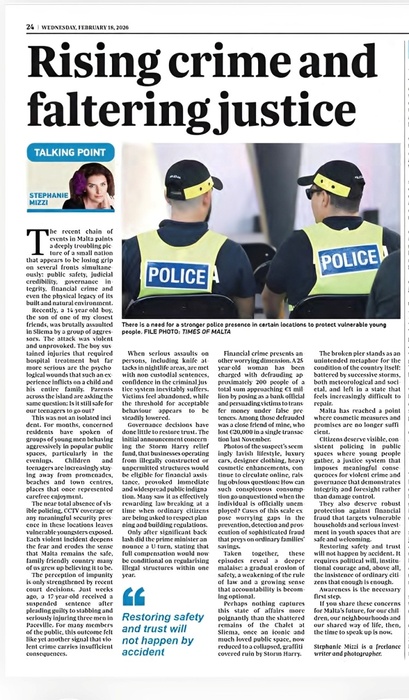
The near-total absence of visible policing, CCTV coverage or any meaningful security presence in these locations leaves vulnerable youngsters exposed. Each violent incident deepens the fear and erodes the sense that Malta remains the safe, family-friendly country many of us grew up believing it to be.
The perception of impunity is only strengthened by recent court decisions. Just weeks ago, a 17-year-old received a suspended sentence after pleading guilty to stabbing and seriously injuring three men in Paceville. For many members of the public, this outcome felt like yet another signal that violent crime carries insufficient consequences.
When serious assaults on persons, including knife attacks in nightlife areas, are met with non-custodial sentences, confidence in the criminal justice system inevitably suffers. Victims feel abandoned, while the threshold for acceptable behaviour appears to be steadily lowered.
Governance decisions have done little to restore trust. The initial announcement concerning the Storm Harry relief fund, that businesses operating from illegally constructed or unpermitted structures would be eligible for financial assistance, provoked immediate and widespread public indignation. Many saw it as effectively rewarding law-breaking at a time when ordinary citizens are being asked to respect planning and building regulations.
Only after significant backlash did the prime minister announce a U-turn, stating that full compensation would now be conditional on regularising illegal structures within one year.
Financial crime presents another worrying dimension. A 25-year-old woman has been charged with defrauding approximately 200 people of a total sum approaching €1 million by posing as a bank official and persuading victims to transfer money under false pretences. Among those defrauded was a close friend of mine, who lost €20,000 in a single transaction last November.
Photos of the suspect’s seemingly lavish lifestyle, luxury cars, designer clothing, heavy cosmetic enhancements, continue to circulate online, raising obvious questions: How can such conspicuous consumption go unquestioned when the individual is officially unemployed? Cases of this scale expose worrying gaps in the prevention, detection and prosecution of sophisticated fraud that preys on ordinary families’ savings.
Taken together, these episodes reveal a deeper malaise: a gradual erosion of safety, a weakening of the rule of law and a growing sense that accountability is becoming optional.
Perhaps nothing captures this state of affairs more poignantly than the shattered remains of the Chalet at Sliema, once an iconic and much-loved public space, now reduced to a collapsed, graffiti-covered ruin by Storm Harry.
The broken pier stands as an unintended metaphor for the condition of the country itself: battered by successive storms, both meteorological and societal, and left in a state that feels increasingly difficult to repair.
Malta has reached a point where cosmetic measures and promises are no longer sufficient.
Citizens deserve visible, consistent policing in public spaces where young people gather, a justice system that imposes meaningful consequences for violent crime and governance that demonstrates integrity and foresight rather than damage control.
They also deserve robust protection against financial fraud that targets vulnerable households and serious investment in youth spaces that are safe and welcoming.
Restoring safety and trust will not happen by accident. It requires political will, institutional courage and, above all, the insistence of ordinary citizens that enough is enough.
Awareness is the necessary first step.
If you share these concerns for Malta’s future, for our children, our neighbourhoods and our shared way of life, then, the time to speak up is now.
The recent chain of events in Malta paints a deeply troubling picture of a small nation that appears to be losing grip on several fronts simultaneously: public safety, judicial credibility, governance integrity, financial crime and even the physical legacy of its built and natural environment.
Recently, a 14-year-old boy, the son of one of my closest friends, was brutally assaulted in Sliema by a group of aggressors. The attack was violent and unprovoked. The boy sustained injuries that required hospital treatment but far more serious are the psychological wounds that such an experience inflicts on a child and his entire family. Parents across the island are asking the same question: Is it still safe for our teenagers to go out?
This was not an isolated incident. For months, concerned residents have spoken of groups of young men behaving aggressively in popular public spaces, particularly in the evenings. Children and teenagers are increasingly staying away from promenades, beaches and town centres, places that once represented carefree enjoyment.
The near-total absence of visible policing, CCTV coverage or any meaningful security presence in these locations leaves vulnerable youngsters exposed. Each violent incident deepens the fear and erodes the sense that Malta remains the safe, family-friendly country many of us grew up believing it to be.
The perception of impunity is only strengthened by recent court decisions. Just weeks ago, a 17-year-old received a suspended sentence after pleading guilty to stabbing and seriously injuring three men in Paceville. For many members of the public, this outcome felt like yet another signal that violent crime carries insufficient consequences.
When serious assaults on persons, including knife attacks in nightlife areas, are met with non-custodial sentences, confidence in the criminal justice system inevitably suffers. Victims feel abandoned, while the threshold for acceptable behaviour appears to be steadily lowered.
Governance decisions have done little to restore trust. The initial announcement concerning the Storm Harry relief fund, that businesses operating from illegally constructed or unpermitted structures would be eligible for financial assistance, provoked immediate and widespread public indignation. Many saw it as effectively rewarding law-breaking at a time when ordinary citizens are being asked to respect planning and building regulations.
Only after significant backlash did the prime minister announce a U-turn, stating that full compensation would now be conditional on regularising illegal structures within one year.
Financial crime presents another worrying dimension. A 25-year-old woman has been charged with defrauding approximately 200 people of a total sum approaching €1 million by posing as a bank official and persuading victims to transfer money under false pretences. Among those defrauded was a close friend of mine, who lost €20,000 in a single transaction last November.
Photos of the suspect’s seemingly lavish lifestyle, luxury cars, designer clothing, heavy cosmetic enhancements, continue to circulate online, raising obvious questions: How can such conspicuous consumption go unquestioned when the individual is officially unemployed? Cases of this scale expose worrying gaps in the prevention, detection and prosecution of sophisticated fraud that preys on ordinary families’ savings.
Taken together, these episodes reveal a deeper malaise: a gradual erosion of safety, a weakening of the rule of law and a growing sense that accountability is becoming optional.
Perhaps nothing captures this state of affairs more poignantly than the shattered remains of the Chalet at Sliema, once an iconic and much-loved public space, now reduced to a collapsed, graffiti-covered ruin by Storm Harry.
The broken pier stands as an unintended metaphor for the condition of the country itself: battered by successive storms, both meteorological and societal, and left in a state that feels increasingly difficult to repair.
Malta has reached a point where cosmetic measures and promises are no longer sufficient.
Citizens deserve visible, consistent policing in public spaces where young people gather, a justice system that imposes meaningful consequences for violent crime and governance that demonstrates integrity and foresight rather than damage control.
They also deserve robust protection against financial fraud that targets vulnerable households and serious investment in youth spaces that are safe and welcoming.
Restoring safety and trust will not happen by accident. It requires political will, institutional courage and, above all, the insistence of ordinary citizens that enough is enough.
Awareness is the necessary first step.
If you share these concerns for Malta’s future, for our children, our neighbourhoods and our shared way of life, then, the time to speak up is now.